You know those minivan and suv commercials where they make the car look like it can do literally anything?
That’s basically the same as a sensory bin.
What is a sensory bin?
A sensory bin is a container filled with a variety of materials cultivated to ignite one or more of the five senses: touch, sight, smell, sound, and taste. You’ve probably seen water tables and sand tables at Target or Walmart. You might even have one in your backyard! There are tons of tutorials on the internet that show how to use pvc pipe and storage tubs to create a cheap table. I’ve found that those plastic under the bed storage tubs straight on the floor work wonders. You can move it anywhere (speaking from experience, don’t try to move it when it’s full) and you can store your materials in it when you’re done!
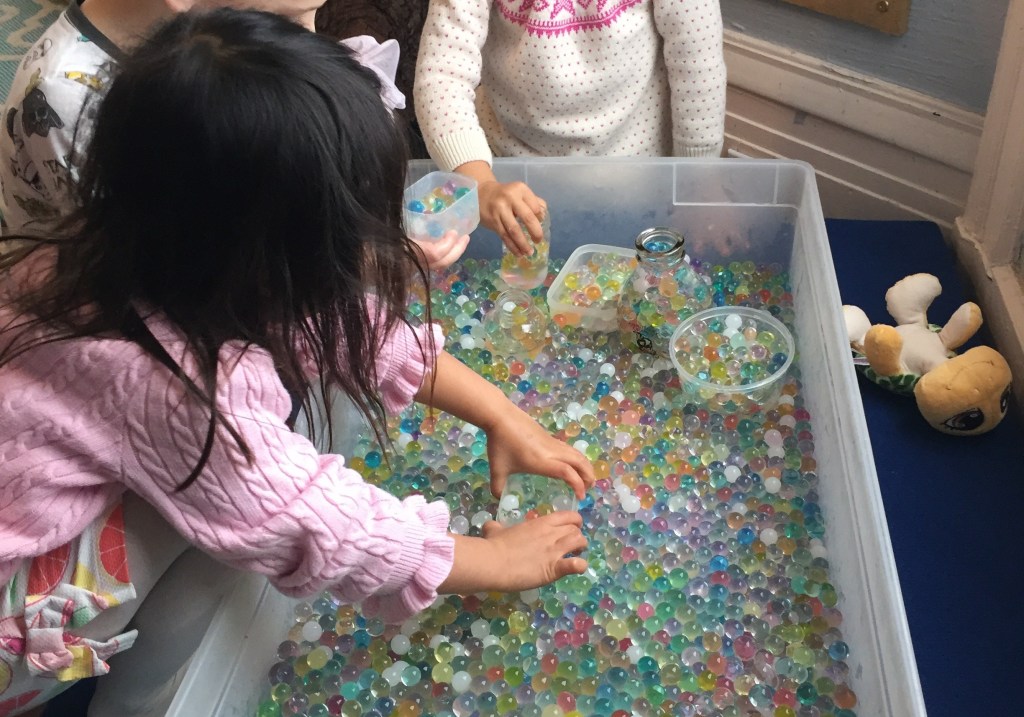
Scroll to the end of this post for a list of materials for your sensory bin!
Why I love sensory bins…
I’ll admit it. Some teachers and parents aren’t as big of fans of sensory bins as I am. They can be messy. If multiple children are sharing a bin, it can take some extra supervision. Sometimes, you even have to redirect kids to a different area of the classroom or *gasp* put away the bin altogether. (This is a practice in setting boundaries and sticking to them. Look at you!)
While some people may see sensory bins as a challenge, I believe the benefits far outweigh any annoyances.
Physical Skills
Probably the most obvious skills supported by sensory bins are physical skills.
Fine motor development (small hand movements) happens as children pick up little toys and manipulative tools like cups and tweezers.
Scooping, pouring, and lifting strengthens arm muscles (gross motor development) and promotes hand-eye coordination. When children fill up jars and pour from one container to another, they work to line the containers up, ensuring that the material goes where they want it to go.
(Read more about fine motor development here and here.)
Social Emotional Skills
Sensory bins lend themselves to independent play, but add in some extra kids and they become a great opportunity to work on those essential social emotional skills. The shared space and materials within a bin requires kiddos to work together. Asking for friends to pass tools to them, waiting their turn to use a material, and navigating the space to ensure everyone has enough room are all skills that are regularly practiced through a sensory bin.
Self regulation is the ability to appropriately manage one’s own emotions. It’s how you can recognize you’re getting too frustrated to keep arguing with someone, so you call a time-out and walk away for a bit. Or why we adults don’t throw a tantrum in the middle of a store when we realize an item we really wanted is too expensive. Sensory bins provide a first step to learning those skills. I can’t even count the number of times I’ve guided an upset child to play with me in a sensory bin and they quickly calmed down — and continued to use it as a “reset button” throughout the rest of the year. We all know that being near water can help us calm down but trust me, there’s just something about running your hands through a sensory bin that has the same effect.
Doing sensory bins at home without other kids around? Your little ones can still hone their social emotional skills if you join in the play! Instead of immediately handing them the spoon you’re using to scoop with, gently tell them that you’re using it but they can have it when you’re done. Play with it a little longer then give it to them accompanied by a kind “Ok, I’m done now. Here you go!” You get to model the behavior you hope to see!
Cognitive Skills
It might be surprising but sensory bins are a perfect place to naturally connect what your little one is doing with larger more academic concepts.
I already mentioned that sensory bins promote cooperative language development but you can also take that opportunity to encourage descriptive language, especially with toddlers. Just stating things like “This water is BLUE.” or “Wow the oobleck is soooo sticky! Sticky sticky sticky!” will help your kiddo pick up on new vocabulary.
The early math concepts of more/less and full/empty are the beginnings of conservation (the ability to understand the volume and mass of an object regardless of the container in which it is placed) while inside/outside and above/below are early concepts in spatial reasoning (the ability to visualize and determine an item’s position in relation to the space it occupies).
Science skills like cause and effect and making predictions happen all the time through mixing materials and prompts of “What do you think will happen when I ________?”
Can’t fill their jar just by scooping? Kids will use problem solving and critical thinking skills to come up with solutions like using another scoop to top it off or scooping from an area with more of the filler.
Sometimes, it’s just about fun.
Obviously, not every time you do a sensory bin with your kiddo has to be or should be about actively encouraging their development. I couldn’t even tell you the number of times my mom gave me a box of cornstarch and told me to go play in the bathroom sink. Sometimes, you just need your kids to play nicely while you cook dinner or wash laundry or give the dog a bath. Sometimes it just needs to be for fun’s sake alone. Sensory bins are perfect for those moments as long as your little one understands your expectations and boundaries. You’ll have the opportunity to work in skill building some other time.
A note about kids who don’t like to get messy…
I won’t lie. In my time working with kids, I’ve encountered a few who avoid sensory bins. Sometimes they’re just a little unsure of a new experience. The approach I’ve used with wary kids is to provide many opportunities to try it out and play it up but never ever ever force their participation and never make them feel bad about choosing not to engage in sensory play. Ask for their input on materials and find a material that works for them. Sometimes water is too much but dry beans aren’t or vice versa. You can even offer gloves to wear to lessen the sensory input. If your child seems consistently sensory averse in a multitude of situations and you’re concerned, speak with your pediatrician. They can assess your personal situation and if needed, refer you to an occupational therapist or developmental pediatrician.
Ok, you’ve convinced me. How can I make a sensory bin to play with at home?
Yea! I’m so happy to share my love with you!
Here’s what you’ll need to make a sensory bin. Just make sure that the materials you choose are appropriate for your child if they are playing independently (avoid choking hazards in independent play) or ensure that you are supervising at all times.
One of the following containers
- A container big enough for the amount of children playing, like an under the bed storage bin
- Multiple small containers for individual use
- A dedicated sensory table if you want to spend the money on it
PLUS: A tarp, shower curtain, or large towel to place underneath the bin to catch any spills (optional but nice to have)
A Base Material
(Not all of these are taste safe and this is not a definitive list by any means.)
- Water (colored with food dye or liquid watercolor optional but more fun)
- Sand
- Dried foods like beans, lentils, pasta, rice, cornmeal, oats, etc
- Oobleck (cornstarch and water)
- Shaving cream
- Ice
- Shredded paper (Give your junk mail life before recycling it!)
- Packing peanuts
- Pellet cat litter or rabbit food
- Cotton balls
- Water beads
Additional Tools and Materials
(Choose more than one or add as you go to extend playtime!)
- Jars or cups
- Spoons and scoops
- Animal figurines
- Ice trays
- Food storage containers
- Child safe tweezers
- Training chopsticks
- Toy cars
- Pom poms
- Popsicle sticks
- String and pipe cleaners (especially if you’re using a pasta that can be threaded like penne or rigatoni)
- The list is endless!
Do you use sensory bins with your kiddos? What do you love about them? Or if not, what’s been holding you back? Let me know in the comments!
 Living Arrows