This is part one of a series on promoting literacy in the infant/toddler – preschool years. You can find part two (choosing quality content for children) here. You can find part three (intention in book selection) here.
As someone whose entire life has revolved around school years, I’ve come to recognize the return to the classroom in late August as the New Year — not January 1st. Vacations are over. The weather cools off. Parents and teachers are out buying fresh school supplies. Things are settling down and falling back into the routines that keep us sane.
Research shows time and time again that establishing and sticking to routines is one of the best things you can do for yourself. It can improve relationships, keep you healthy, minimize stress, and more.
In the case of children five years old and under, routines are essential for setting them up for success in school (and life), especially with regards to reading.
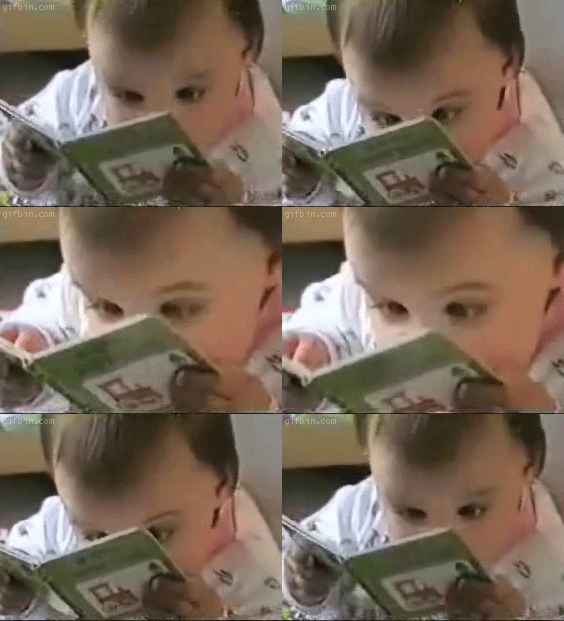
Parents are told that to build up their children’s vocabulary, they need to talk to them often. If talking is good, then reading is better. According to research by Dominic Massaro, a professor of psychology at the University of California, Santa Cruz, we tend to use the same words over and over again when speaking, but reading aloud to children exposes them to a more varied vocabulary.
For example, 13 Words by Lemony Snicket includes the words “despondent” and “haberdashery.” I think it’s safe to say that other than people who sell hats or play Alexander Hamilton in Hamilton: An American Musical most normal people don’t use those words on a regular basis.
Mem Fox, a well regarded champion of early literacy, reminds us in her book Reading Magic that it’s never too early to start reading to children nor does really matter what we read to them when they are babies. The important thing is to establish the routine. My mother-in-law often credits my husband’s writing skills to the many mornings she spent reading the newspaper aloud to him while sipping her coffee. My mother credits my early reading age to the obsession I had with books (and my older sister’s obsession with playing school). My sister began a bedtime reading routine very early on with her daughter and now, as a toddler, she entertains herself with only books for long periods of time. She’s not even two yet and she already has a love for books.
As your babies grow into preschoolers, your reading routines will change. A few years ago, I was teaching a class of about 14 two and a half year olds. If you’ve ever sat in on snacktime with two and a half year olds, you’ll know that some eat incredibly fast while some eat incredibly slow. You’ll also know that trying to keep a two and a half year old in a chair when they’re ready to move onto the next thing isn’t easy. To manage our transition and maintain classroom safety, we started “Quiet Reading” knowing fully that it would not be quiet at all but would eventually become so as they grew older and older and we continued the routine. Every day during snack, one teacher would gather enough books and display them in an intriguing way in a room with very few other toys. As the children finished their snacks, they could come into the room to “read” books while they waited for their friends. We had very few spoken expectations for them during this time: 1) they could read by themselves, with a friend, or with a teacher, 2) they had to treat the books with care, and 3) the other toys in the room were off limits until we said otherwise.
Early on in the year, we used only board books and the other toys were often pulled out after about 5-10 minutes. Each week we practiced gentle bookhandling skills and pushed the boundaries of the children’s attention spans further and further until by the end of the year, we were providing a larger number of picture books and those same children would spend a full 45 minutes just reading and sharing books with their friends. There were even times when we teachers would stand back to watch them all engaged in reading while we discussed how we could adjust our day to give them more time to read.
The following year, the same group of children still loved “Quiet Reading” which actually was gradually getting quieter. They spent much of their time acting out their favorite books in our dramatic play center and at the end of the year even produced and presented the classic story “The Little Red Hen” as a play for their families. In their very last year of preschool, they worked together to research, write, and publish their very own newspaper.
Trace all of this back to the beginning and what do you find?
ROUTINE.
I cannot stress enough how important reading routines are.
If you asked me for one single thing you should do to prep your child for kindergarten, I would tell you to start and stick to a reading routine — and start early. Like with your baby early.
Why?
It prepares your kid to be able to give their attention when their teacher is reading a book to them during circle times.
It exposes them to new words and increases their vocabulary.
It gives you an opportunity to talk with your child about events and emotions that occur within the plot and illustrations of the story.
You even get quality time together.
Your routine doesn’t have to look like my routine. It doesn’t have to look like your friend’s routine. It doesn’t matter if you read to your kids when they wake up in the morning, before they go to bed at night, or some time during the day. You just need to have a routine so that a day without reading feels like a day without air.
PS: ALWAYS include books alongside toys as an option during independent play. For babies, provide soft books. For toddlers, provide board books and sturdy books. For preschoolers who are more practiced in gentle bookhandling, provide picture books that you are ok with getting accidental tears.
 Living Arrows
Pingback: Literacy Before Kindergarten: Go for the Gold | Living Arrows
Pingback: Literacy Before Kindergarten: Intention in Book Selection | Living Arrows