“Passion is lifted from the earth itself by the muddy hands of the young; it travels along grass-stained sleeves to the heart.”
— Richard Louv, Last Child in the Woods: Saving Our Children from Nature-Deficit Disorder
Being outdoors is a magical experience. Even as adults, we love to “get away from it all.” We often spend lots of money so we can go relax on a beach, camp, hike, or sit on a porch in the mountains. We crave getting back to nature. It helps us forget about the mundane aspects of life: bills, work, to do lists…
Recently, the early childhood field has seen an uptick in “nature schools” in which the outdoors is the classroom. At my last preschool in San Francisco, many of the children had limited outdoor space at their homes. Those who did often had small, shared, or hardscaped backyards. Thankfully, San Francisco has a great parks system and we took advantage of that. Nature wasn’t our everyday classroom, but at least once a week, our classes didn’t meet at our schoolhouse; we spent the day exploring in one of the city’s beloved parks.
The open space that nature provides gives children a plethora of wonderful opportunities. Kids get a chance to move and challenge their bodies in a way that they don’t necessarily get at school or on the playground. The simple freedom of being able to run ahead on a trail, screaming and yelling without being told “We need to be respectful of the other classes in the hallway” or “Shhh, the baby is sleeping” is huge for a four-year-old. The lack of walls and toys, the ability to spread out, to get much farther away from your teacher, parent, or caregiver than you typically can…it all promotes this feeling of being unsupervised (even when adults are watching like hawks).
I’m reminded of the many times I took my preschool classes to an area of a park with an exposed tree trunk on a sandy hill. The kids could climb up the roots and into the hollow in the stump and survey the land around them. Sometimes, the climb down would become intimidating. When this happened, we teachers would encourage nervous children back down the tree stump to the ground. Often, the children coached each other, showing different footholds along the way.
There are two important things I learned from all that coaching.
- The closer we adults were when they got nervous, the sooner they turned to us for help, even if they had climbed down hundreds of times before.
- After those children who needed help reached the ground, they had one of two reactions:
- Oozing excitement and pride at their accomplishment, giddy with new found bravery, even if they had been in tears while climbing down
- Practicing more forethought when climbing so they wouldn’t need assistance again
We could have easily plucked our nervous climbers out of the tree stump but we would have deprived them of an opportunity to realize their own capabilities and calculate the benefits and risks of their actions. Who knows if they would have climbed up that stump ever again?
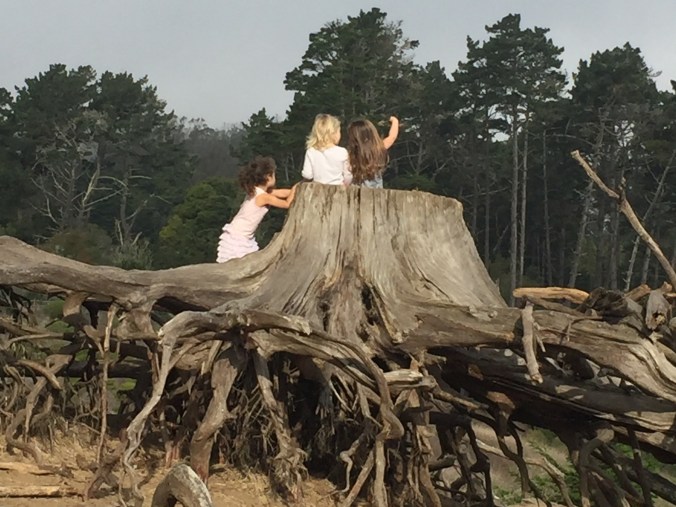
When kids aren’t climbing trees or running down the trail, they’re making use of the abundance of open-ended materials found in nature. An open-ended material is anything without a defined purpose that provides for rich imaginative play. A teacup will always be a teacup. A matchbox car will always be matchbox car. None of the “toys” we find in nature has a defined purpose. A pinecone can just as easily be a giant piece of candy as it can be a laser gun. A stick can be a fishing pole or a magic wand. A broken branch from a tossed Christmas tree can be an axe or a fan. These natural, open-ended materials draw children into their magic. They can be anything the children want them to be. They even bring us adults into the magic too; when a child hands me a rotting piece of bark and tells me with conviction that it’s a chocolate bar, I believe her.
Playing outdoors demands creativity and problem-solving. It challenges children come up with ideas together.
What can we play?
What do we need?
Who can help us?
And when they’re presented with a problem – maybe someone is upset because they want to play a different character – they can work to find a way to solve it together.
What’s that you say?
You don’t have an open nature space near your home?
You don’t have time to fit a nature day into your busy schedule?
That’s ok.
While there’s no substitute for the experience and freedom that playing in nature provides, you can try to replicate it at home.
- Ensure you have a number of open-ended materials for your child to play with.
- Talk to your child care provider about their practices for going outdoors. Volunteer to be a field trip chaperone out to an open space if that’s what they need.
- Let your child play independent of you. Take a step back on the playground. Always be aware of their situation and safety, but be slow to solve their problems for them.
- Get out into nature as often as you can.
- Overcome your own misgivings about bugs and dirt and sweat.
- Learn about, experience, and enjoy the beauty of the natural world alongside your little one.
Click here for more on the benefits of natural outdoor play environments.
Click here to learn about The Land, an “adventure playground” in Wales.
 Living Arrows
This is a great post!
LikeLike
Pingback: Four Favorites: Gross Motor Experiences | Living Arrows